Aggression in Horses: What Your Horse Is Trying to Tell You
Oct 02, 2026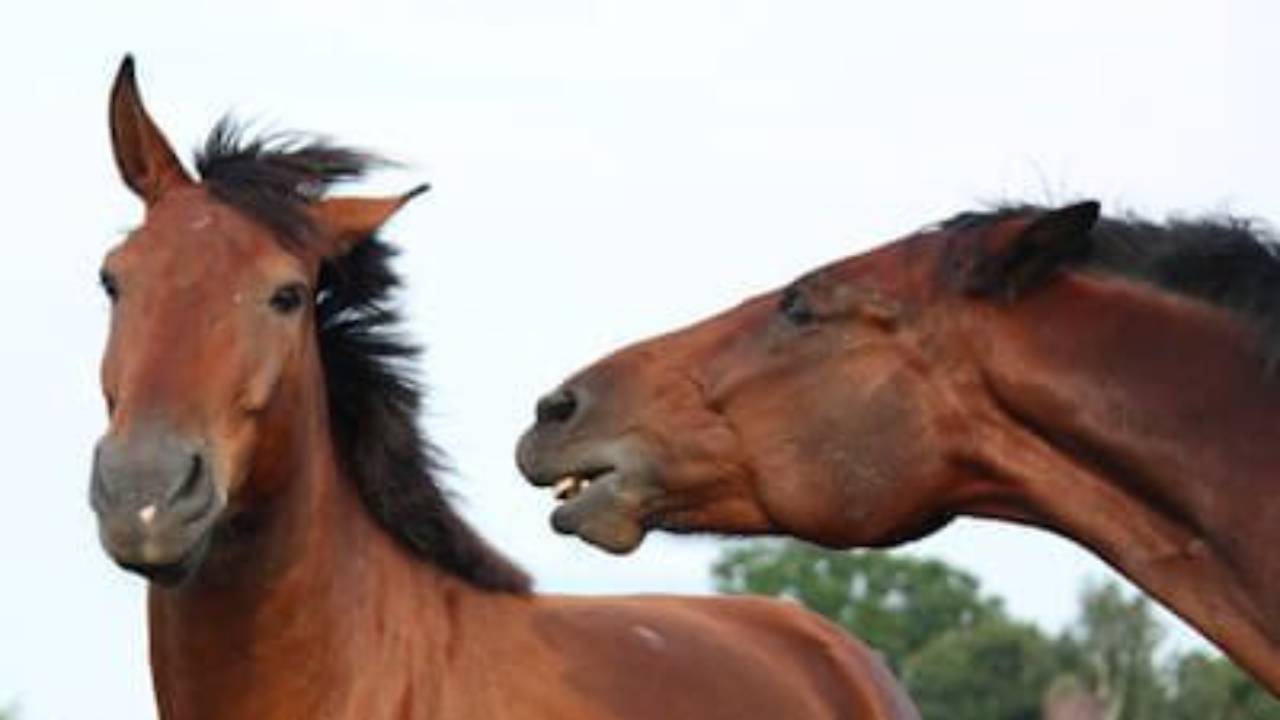
Quick answer: Aggression in horses is communication, not a character flaw. Biting, kicking, charging and pinned ears are usually a horse's last resort to protect themselves, and almost always trace back to one of three drivers: pain, fear or frustration. Rule out pain first, then look at the horse's environment, history and relationships. Punishing aggression removes the warning signals that come before it and makes sudden, more dangerous behaviour more likely.
Why do horses become aggressive?
When a horse bites or kicks, it's tempting to see a "bad attitude" or a dominant personality. In over twenty years of working with horses and their people, I've found the opposite is true. Aggression is a horse telling us, as loudly as they can, that something isn't right and that quieter messages haven't been heard.
Almost every case comes back to three drivers.
- Pain. Ongoing discomfort lowers a horse's tolerance and makes defensive behaviour far more likely.
- Fear. A horse who feels unsafe and has no way to leave the situation may defend themselves instead.
- Frustration. Blocked access to food, companions or movement builds tension that spills over, often around feeding time or gateways.
These drivers often overlap. A horse in mild pain is more easily frightened, and a frightened horse in a restricted environment becomes frustrated quickly.
Is my horse aggressive because they're in pain?
Pain should always be ruled out first, even when a horse has recently had a clear veterinary check. Low-level or intermittent pain can be hard to detect in a standard examination, yet it can lower a horse's defensive threshold considerably.
The research supports this. A study of riding school horses found that those who were aggressive towards people were more likely to have vertebral problems, suggesting chronic pain was contributing to their behaviour (Fureix et al., 2010). Behavioural ethograms have also been developed to help owners and vets recognise discomfort through behaviour, both under saddle (Dyson et al., 2018) and in everyday life (Torcivia and McDonnell, 2021).
If you suspect pain, arrange a full veterinary assessment and consider a qualified bodyworker to help identify muscular tension. Recording when the behaviour happens, and in what context, makes that conversation far more productive. I'd recommend Equine Voice for this: it lets you log behaviour over time, and the premium subscription generates a report you can share directly with your vet. If your vet isn't receptive to behavioural evidence, it's reasonable to seek a second opinion.
What are the warning signs before a horse bites or kicks?
Very few horses go from relaxed to aggressive without warning. Most move up a communication ladder, starting with whispers and only shouting when those whispers are ignored. Early signals can include:
- stiffening or holding the breath
- rapid blinking or a tight eye
- ears turning back or flicking towards you
- a tense muzzle or clamped lips
- swishing the tail or shifting weight away
- turning the head or body away
Responding to these early signals, by pausing, giving more space or changing what you're doing, lets you de-escalate before the horse feels they need to bite or kick.
A simple traffic light system helps. Green means the horse is relaxed and you can carry on. Amber means early signs of tension, so slow down and give the horse more choice. Red means stop, create distance and reassess.
Should you punish a horse for biting or kicking?
Punishment may stop the behaviour in the moment, but it doesn't change the reason behind it. Worse, it teaches the horse that warning signals lead to punishment, so they stop giving them. The pain, fear or frustration remains, but the ladder disappears, and the next response is more sudden and more dangerous. Equitation scientists have long cautioned against punishment for exactly these reasons (McGreevy and McLean, 2009).
Pushing a horse through handling while they're uncomfortable carries a further risk. Some horses stop resisting not because they feel better, but because they've given up. This shutdown can look like calm, but it is closer to learned helplessness (Hall et al., 2008).
How do you help an aggressive horse?
A horse in a negative emotional state can't learn effectively. Before any training, the goal is to help them reach at least a neutral state, and ideally a positive one. This is the foundation of the Five Domains Model, which assesses welfare through a horse's mental experience as well as their physical needs (Mellor et al., 2020).
- Rule out pain with a full veterinary assessment.
- Meet the basics: friends, forage and freedom. Constant access to forage, compatible companions and room to move are the first steps out of a negative state.
- Remove pinch points. Conflict around feed, water and gateways increases when resources are concentrated (Burla et al., 2016). Spreading hay piles and widening access often reduces aggression between horses quickly. Resource guarding frequently comes from a horse feeling they lack personal space.
- Make handling predictable. Inconsistent routines create anxiety that builds into sudden reactions. Horses also learn by watching, so they can form associations with people from how they see those people treat other horses.
- Use calming cues. Simple activities such as chewing damp chaff can help a horse regulate during moments of anticipation or frustration.
- Add targeted enrichment. Scent work, foraging puzzles and choice-based activities support a more positive emotional state. See Beyond the Basics: Creating Truly Enriched Environments for Horses.
- Notice your own state. Horse and human nervous systems influence each other. When handlers were led to expect something worrying, their horses' heart rates rose too (Keeling et al., 2009), and human stress has been linked to changes in horse heart rate and behaviour (Merkies et al., 2014).
For horses with past trauma, these steps matter even more. Frightening experiences create deep, easily triggered pathways that stay active unless the horse has repeated chances to feel safe. Read more in Where Did That Come From? and Be Trauma Informed.
Frequently asked questions
Why does my horse pin their ears at me?
Pinned ears are a clear request for space. The horse may be uncomfortable, worried about food or resources, or anticipating something unpleasant. Give them space, check for pain, and look at what happened just before.
Can an aggressive horse be helped?
Yes. Once the underlying cause is identified and addressed, most horses become far calmer. Change usually comes from pain management, environmental changes and rebuilding trust rather than from training alone.
Is my horse aggressive because they're dominant?
Rarely. What looks like dominance is usually competition caused by limited resources, or a defensive response to pain or fear. Changing the environment often changes the behaviour.
Why has my horse suddenly become aggressive?
A sudden change in behaviour is a strong indicator of pain or illness. Contact your vet, and record when and where the behaviour happens.
Want to go deeper? I explore aggression, communication and the nervous system in my free live Q&A sessions, where you can bring questions about your own horse. Find the next session here.
References
- Burla, J.-B., Ostertag, A., Patt, A., Bachmann, I. and Hillmann, E. (2016) Effects of feeding management and group composition on agonistic behaviour of group-housed horses. Applied Animal Behaviour Science, 176, 32–42.
- Dyson, S., Berger, J., Ellis, A.D. and Mullard, J. (2018) Development of an ethogram for a pain scoring system in ridden horses and its application to determine the presence of musculoskeletal pain. Journal of Veterinary Behavior, 23, 47–57.
- Fureix, C., Menguy, H. and Hausberger, M. (2010) Partners with bad temper: reject or cure? A study of chronic pain and aggression in horses. PLoS ONE, 5(8), e12434.
- Hall, C., Goodwin, D., Heleski, C., Randle, H. and Waran, N. (2008) Is there evidence of learned helplessness in horses? Journal of Applied Animal Welfare Science, 11(3), 249–266.
- Keeling, L.J., Jonare, L. and Lanneborn, L. (2009) Investigating horse–human interactions: the effect of a nervous human. The Veterinary Journal, 181(1), 70–71.
- McGreevy, P.D. and McLean, A.N. (2009) Punishment in horse-training and the concept of ethical equitation. Journal of Veterinary Behavior, 4(5), 193–197.
- Mellor, D.J., Beausoleil, N.J., Littlewood, K.E., McLean, A.N., McGreevy, P.D., Jones, B. and Wilkins, C. (2020) The 2020 Five Domains Model: including human–animal interactions in assessments of animal welfare. Animals, 10(10), 1870.
- Merkies, K., Sievers, A., Zakrajsek, E., MacGregor, H., Bergeron, R. and König von Borstel, U. (2014) Preliminary results suggest an influence of psychological and physiological stress in humans on horse heart rate and behavior. Journal of Veterinary Behavior, 9(5), 242–247.
- Torcivia, C. and McDonnell, S. (2021) Equine Discomfort Ethogram. Animals, 11(2), 580.
About the author
Nicky Ross is an applied equine behaviourist and founder of Horse Play Highlands, with around 20 years of experience in animal behaviour. Nicky's case study work is published in CABI's peer-reviewed literature (Ross, 2025).
Want to dive deeper? Join our free masterclass, 'Through Horses' Eyes'.
